
The criteria are simple: did the president expand state power, wage wars, raise taxes and debt, meddle with money, and erode individual liberty?
The pattern is clear—the more a president “gets done,” the less free the individual becomes.
Lincoln, Roosevelt, and the other “great presidents” all sink to the bottom tier, while Jefferson and Coolidge rise to the top.
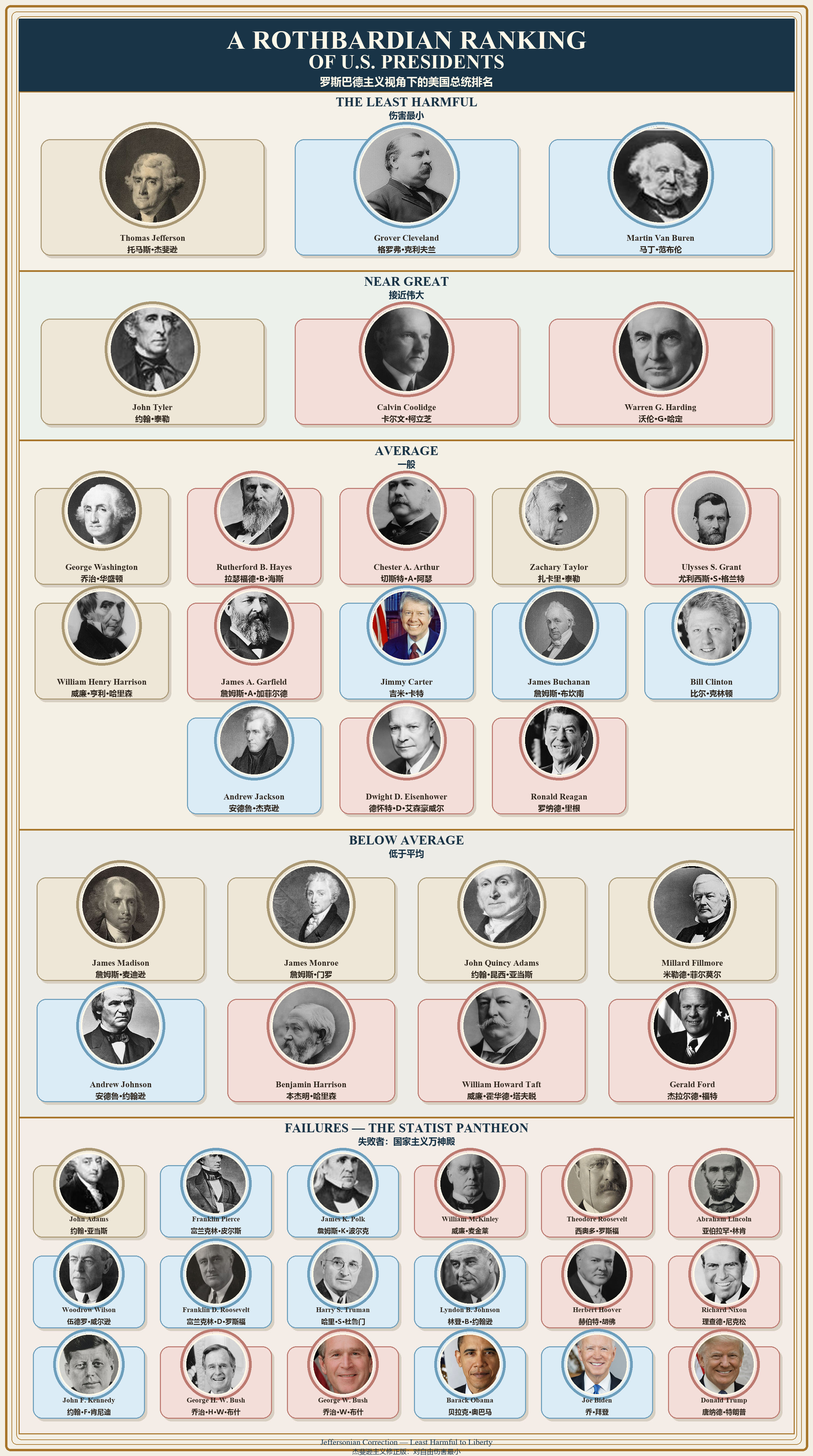
Mainstream history judges presidents by how many big things they accomplished and how much glory they left behind.
The Austrian School asks only one question: how much did he expand the power of the state?
Here the highest honor isn’t “great”—it’s “harmless.”
The mainstream narrative loves wars, crises, and reforms.
Because only in such times can a president show “leadership”: mobilizing the nation’s resources, building new agencies, signing sweeping new laws.
The price is higher taxes, debt, inflation, conscription, and regulation—and a shrinking sphere of individual liberty.
That is why a ranking of presidents through Austrian eyes is almost a mirror image of the conventional one.
Jefferson and others rank highly because they were relatively respectful of limited government, fiscal restraint, hard money, and non-intervention.
Coolidge and Harding earn praise too, for cutting taxes and slashing spending.
Conversely, Lincoln concentrated power for war and brought in conscription, an income tax, and paper money;
Wilson created the Federal Reserve, expanded the income tax, took America into World War I, and suppressed antiwar speech;
Franklin D. Roosevelt pushed through the New Deal, swelled the administrative state, and cracked down on private ownership of gold.
The achievements celebrated in mainstream history books are precisely the evidence against them in Austrian eyes.
War is also a dividing line.
The wars and foreign interventions several presidents pursued brought not only casualties and military spending, but also left behind a military-industrial complex, an intelligence apparatus, and a surveillance system.
Wars may end, but the warfare state rarely disappears on its own.
Money is the hidden thread running through it all.
When a central bank pushes down interest rates through credit expansion, it breeds malinvestment and the business cycle; inflation is a hidden tax levied without a vote.
When Nixon closed the gold window, the government finally broke free of the discipline of hard money; ever since, debt and monetary expansion have been far harder to restrain.
Party labels mean nothing either.
Reagan talked against big government, yet spending and debt kept climbing; Trump championed “America First,” yet expanded tariffs, deficits, and executive power.
Democrats build the welfare and regulatory state; Republicans build the military, border, and police state. Both roads lead to the same place: bigger government.
The more power a modern president holds, the more likely he is to land in the low-scoring zone.
The Federal Reserve, the income tax, the standing army, the welfare system, and the administrative bureaucracy pile up layer upon layer, and every crisis becomes the excuse for another round of expansion.
From the Austrian perspective, the president truly worthy of praise is not the one who is best at wielding power, but the one who is willing to give it up.